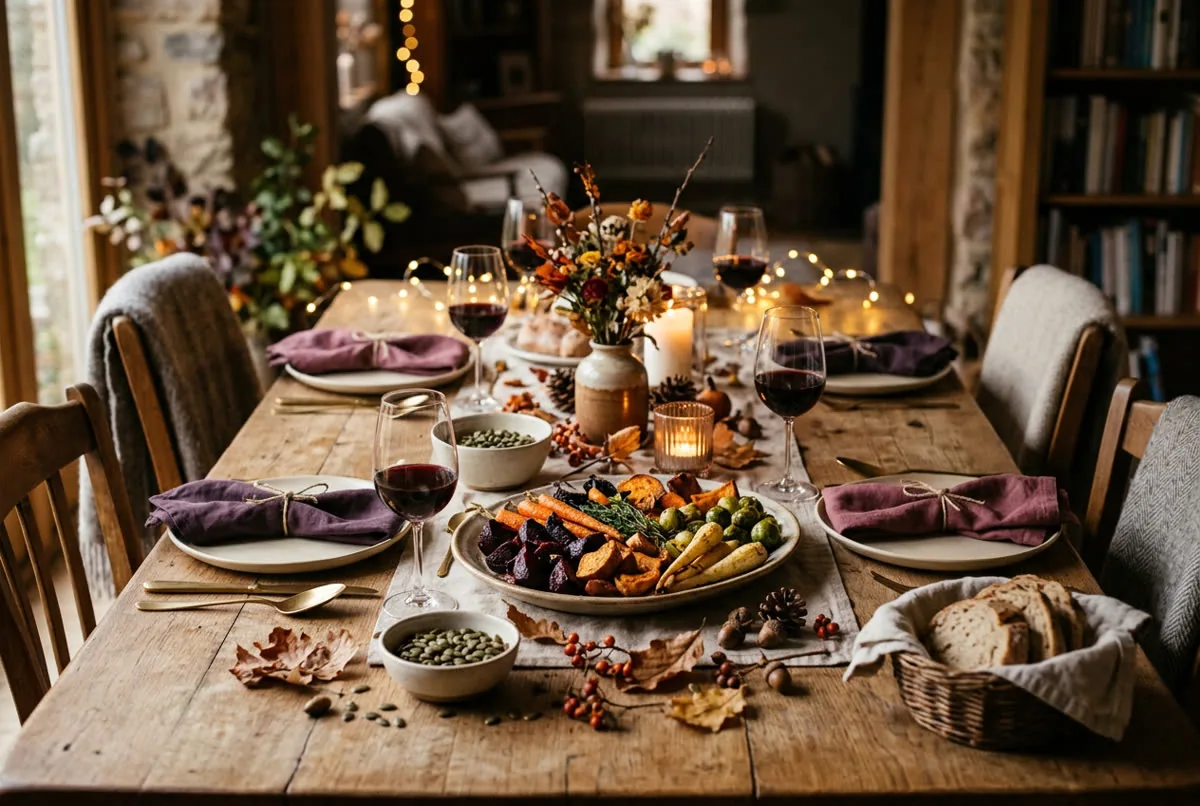
You already know the drill. The group chat lights up with Friendsgiving plans weeks out, someone’s apartment gets a folding table and string lights, and you show up with the good wine because you always do. Then Thursday comes and you’re back at a family table, the only one without a plus-one, half-listening for the question about when you’re finally bringing someone home. Somewhere in between, it’s easy to file Friendsgiving as the fun placeholder you throw before the holiday that actually counts.
The short answer: Friendsgiving isn’t a stand-in for the holiday you’re supposed to be having. It’s the holiday a sizable share of adults, coupled and single, are choosing on purpose, and treating it as a booby prize says more about an old script than about your actual life.
Why Friendsgiving Isn’t the Consolation Round
Friendsgiving has quietly stopped being a workaround. A 2023 Green Giant survey of 1,000 U.S. consumers found nearly half planned to attend at least one Friendsgiving, and 60% of the people who celebrate it said they think it’s more fun than traditional Thanksgiving (Blue Book Services, 2023). Statista’s numbers point the same way: about 20% of Americans said they planned to celebrate Thanksgiving with friends, and the option is most popular with people between 18 and 44, which is to say, your actual demographic (Statista, 2024-11-27).
That matters because a rising share of adults are single: in 2019 about 38% of U.S. adults ages 25 to 54 were unpartnered, up from 29% in 1990, so for a lot of women Friendsgiving isn’t a side event tacked onto the “real” holiday. It’s the primary gathering (Pew Research Center, 2021-10-05). When that many of the adults you know are in the same boat, the boat isn’t a lesser one. It’s just the one a lot of people are actually in.
The quiet story a lot of us carry is that Friendsgiving is what you do when you couldn’t land a seat at a “real” table. The numbers don’t back that up. They point to a lot of people actively choosing the friend version because it comes with less obligation and more joy. That’s not a downgrade. That’s a preference, and you’re allowed to share it.
Turning Chosen Family Into Something Secure, Not Just Convenient
Pew’s research on Thanksgiving found that 73% of U.S. adults say family time is one of the most important aspects of their life, and the same roundup reports that about six in ten say having close friends is very or extremely important for a fulfilling life (Pew Research Center, 2023-11-20). Chosen family isn’t a workaround for real family. For a lot of single women, it is the family, and it’s worth treating that way instead of as a placeholder until something more “official” shows up.
Attachment researchers studying singlehood have identified a secure subgroup of singles, distinct from anxious and avoidant subgroups, and found that these groups differ in how they experience being single and in their well-being (Journal of Personality, 2024). A secure stance doesn’t come from pretending the holiday never stings. It comes from treating your relationships, romantic or not, as things you build on purpose rather than things that happen to you while you wait for a different life to start.
Say the quiet part out loud
If Friendsgiving matters to you, tell your friends that directly instead of hoping they infer it. “This is my favorite night of the year and I want us to actually do it right” lands differently than quietly hosting and hoping someone notices the effort.
Make it a ritual, not a rescue
A one-off dinner feels like a favor everyone’s doing you. A yearly tradition, same weekend, same people, feels like an institution you built. Pick a recurring detail, a dish, a toast, a seating chart joke, and repeat it on purpose. Repetition is what turns a gathering into a chosen family.
Let people show up as themselves, not as understudies
It’s tempting to treat Friendsgiving as a practice round for the “real” holiday, matching china, a seating chart, a menu that performs effort. Chosen family doesn’t need to be rehearsed. The people who keep showing up year after year aren’t grading the tablescape. They’re there for the version of you that isn’t managing a family dynamic, and that’s worth protecting on its own terms rather than dressing it up to look like something more legitimate.
What to Do When You’re the “Single Friend Project” at the Table
Some of this year’s guest list will include coupled friends who mean well and still ask the questions you’re tired of answering: the update on the last date, the “any prospects” check-in, the gentle nudge toward an app you’ve already deleted twice. None of it usually comes from malice. It comes from people who love you and don’t fully know what to do with your timeline not matching theirs. That doesn’t make it less tiring to field for the third year running, and it doesn’t mean you owe anyone a status update on your love life to earn a seat at the table you helped set.
A few boundaries that hold up without turning into a scene:
- Have one line ready and use it every time. Something like “I’m good, genuinely, let’s talk about literally anything else” does the job without a debate.
- Redirect instead of explaining. You’re not obligated to justify why you’re single, why you haven’t downloaded an app, or why your last date didn’t turn into a relationship. Redirect the question back to the group.
- Notice the pattern, not just the person. If one friend tends to circle back to your relationship status every time you gather, that’s worth a private, calm conversation before the next holiday, not a public correction mid-dinner.
- Bring your own plus-one energy. Invite a friend who’s also single, or come solo and own it. You don’t need a date to belong at a table you’re hosting or helping host.
None of this requires diagnosing anyone’s motives. Most people asking tend to be curious or clumsy, not cruel. The boundary is for your peace, not their punishment, and a friend worth keeping will take the redirect and move on without needing an explanation for why you set it.
Handling the Comparison Without Faking It’s Fine
Some years the joy is uncomplicated. Other years, watching coupled friends fold into their partners across the table brings up something real, a version of the holiday you pictured with someone specific, or just a future you thought would already be here by now, and pretending it doesn’t is its own kind of exhausting. You’re allowed to feel both at once: genuinely glad to be at this table, and genuinely a little sad about the table you pictured for yourself at some point. Neither cancels the other out, and you don’t have to pick which one is the “real” feeling to have for the night.
A few ways to hold that without spiraling or performing:
- Name it to one trusted person before the event, not mid-dinner. “I might get a little quiet around dessert, it’s not about tonight” gives someone context without turning you into the group’s emotional weather report.
- Give the feeling a time limit. Ten minutes in the kitchen, a walk around the block, whatever lets you feel it without narrating it to the whole room.
- Separate the holiday from the story you’re telling about it. Missing a specific person or a specific future is different from believing something is wrong with you for not having it yet. The first is grief. The second is a story worth questioning.
If the sadness around holidays like this one feels heavier than a few hard hours, or it’s tangled up with bigger grief, a breakup, or anxiety that doesn’t lift, that’s worth bringing to a therapist rather than working through alone at a dinner table. This article isn’t a substitute for that kind of support, and there’s no prize for toughing it out solo.
Where the Self-Worth Work Actually Pays Off
The women who stop treating singleness as a waiting room tend to have done real work on how they see themselves outside of a relationship, not despite being single but as part of building the kind of confidence that makes future relationships work better too. That work rarely happens by accident over a single dinner. It’s usually the result of deliberately reconnecting with who you are when no one’s watching for a status update, the version of you Friendsgiving actually gets to see because it isn’t performing for anyone’s approval.
Programs like Feminine Enchantment are built around a related idea: changing how you show up, using what the program calls feminine behaviors, rather than running a script on a man (Feminine Enchantment). It’s not a fix for a holiday feeling. It’s the longer-term version of the same idea this article is making: you’re not less because you’re not coupled right now, and building genuine self-worth isn’t a consolation prize either. It’s the thing that makes every table you sit at, chosen family or otherwise, feel like it’s actually yours. If dating apps were part of what drained you this year, the dating app burnout reset covers the same ground from the other direction.
If Friendsgiving this year leaves you wanting to build that foundation on purpose instead of waiting for it to show up with a partner, that’s a reasonable next step, not an admission that something’s broken.
Why Your Table Looks Different From Your Mother’s
The calendar you inherited from the last generation has moved. In 1975, the median age at first marriage for women in the U.S. was 21.1. By 2025 it was 28.4, and for men it rose from 23.5 to 30.8 (U.S. Census Bureau, 2025-12-02). The typical woman marrying for the first time is now closer to 28 than to 21, so being unmarried in your twenties is not running behind. The schedule changed.
The households changed with it. Fewer than half (47%) of U.S. households in 2025 were married couples, down from 66% in 1975. There were 39.7 million one-person households, about 29% of all households, up from 20% in 1975 (U.S. Census Bureau, 2025-12-02).
These are national estimates, not a forecast for your life, and they can’t tell you how any one Thursday will feel. They do answer a quiet worry: that everyone else already arrived somewhere you haven’t. More than half of U.S. households are not married couples, so a Friendsgiving table with a mix of couples, singles, and chosen family looks a lot like the country does now.
The Next Step
Pick one thing from this list before the holiday actually arrives: tell your friends Friendsgiving matters to you and ask for the effort to match, write your one boundary line down so it’s ready before someone asks the question, or name to a friend that this year might bring up more than usual so you’re not carrying it alone. You don’t need a plus-one to make this holiday count. You need people who show up on purpose, and increasingly, that’s exactly what Friendsgiving already is.
Frequently Asked Questions
- Is Friendsgiving really becoming more popular, or does it just feel that way?
- It's real. A 2023 Green Giant survey found nearly half of U.S. consumers planned to attend at least one Friendsgiving, and Statista's 2024 survey found about 20% of Americans planned to celebrate Thanksgiving with friends, most commonly among 18 to 44 year olds.
- Why does Friendsgiving feel like such a big deal for single women specifically?
- Pew Research found that in 2019 about 38% of U.S. adults ages 25 to 54 were unpartnered, up from 29% in 1990, so for a lot of women a friend-based holiday isn't a backup plan. It's the primary gathering they actually look forward to.
- Is it wrong to count friends as 'family' for the holidays?
- No. Pew Research found 73% of U.S. adults say family time is one of the most important parts of their life, and about six in ten say close friends are very or extremely important for a fulfilling life. Valuing both is normal.
- Does being single at the holidays mean something is wrong with me?
- No. Attachment research on singlehood has identified a secure group of singles, distinct from anxious and avoidant groups, and found that these groups experience being single in different ways. Relationship status isn't a measure of your worth.
Sources & references
- Blue Book Services, Green Giant Friendsgiving survey (opens in new tab)
- Statista, Thanksgiving, Friendsgiving or Home Alone? (opens in new tab)
- Pew Research Center, Rising share of U.S. adults living without a spouse or partner (opens in new tab)
- Pew Research Center, 6 facts about Americans and family (opens in new tab)
- Journal of Personality, Diversity in singlehood experiences (opens in new tab)
- Feminine Enchantment, official sales page (opens in new tab)
- U.S. Census Bureau, America's Families and Living Arrangements estimates (opens in new tab)
Before you go
The 3 Texts That Break a Dead Silence
Three word-for-word texts that restart a gone-quiet conversation without chasing or pressure — free, straight to your inbox. No spam, unsubscribe anytime.
Free guide
The 3 Texts That Break a Dead Silence
Three word-for-word texts that restart a gone-quiet conversation without chasing or pressure — free, straight to your inbox. No spam, unsubscribe anytime.